
The Football Fan's Guide to Semi-Automated Offside
Semi-automated offside technology, or SAOT, is a football officiating system that helps VAR teams identify offside positions faster and more consistently. FIFA introduced it at the 2022 World Cup in Qatar, while UEFA competitions and the Premier League have since adopted related systems across Europe. SAOT combines player-tracking cameras, artificial intelligence, a computer-generated offside line and, in advanced installations, a sensor inside the official match ball. FIFA’s 2022 system tracked 29 body points and produced alerts in roughly 25 seconds, although the referee and VAR officials still had to confirm the decision. The system does not replace Law 11, the assistant referee or the referee’s judgment. It mainly reduces the time required to locate the exact kick point and compare eligible body parts. For reliable match analysis, separate the automated alert from the final human decision and check which competition’s implementation is being used.
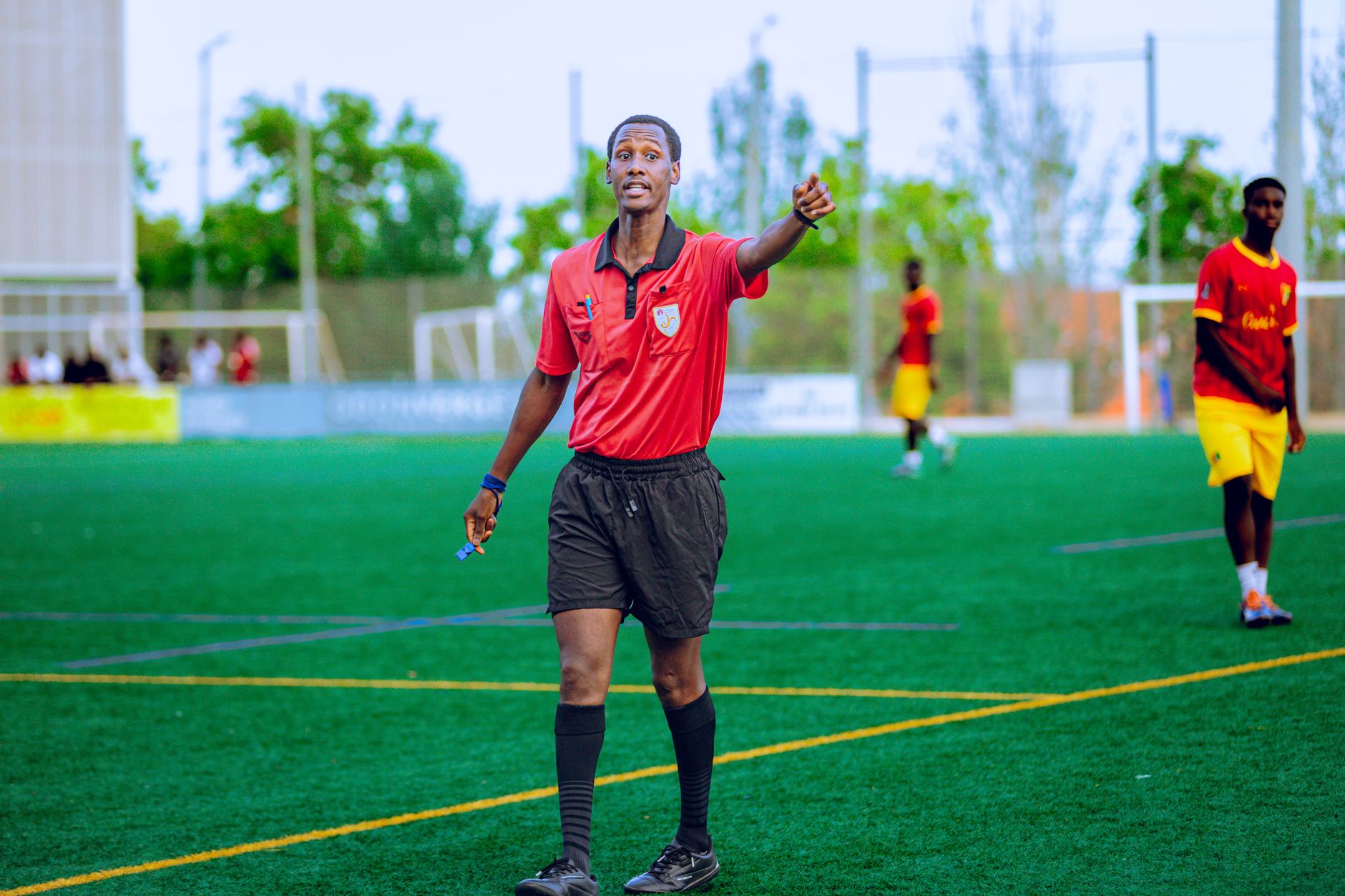
Photo by El gringo photo on Pexels
Semi-automated offside technology sounds more futuristic than it really is. That is probably useful. It is not an autonomous referee making every call. It is a decision-support system, built to handle the tedious geometry while officials handle the football judgment.
For readers following match tactics, player statistics and tournament predictions, this distinction matters. World Cup Hub covers the 2026 FIFA World Cup with that same practical lens. A narrow offside can change a goal, a betting market and an entire tactical interpretation, but SAOT does not make every disputed moment automatically correct.
Want the technical explanation before the next major match?
Step 1: Identify the exact offside event
What does semi-automated offside technology actually identify?
SAOT identifies a possible offside offence by locating players and the ball at the instant a teammate plays or touches the ball. It compares the attacker’s eligible body parts with the second-last opponent and the halfway line, as required by Law 11. The alert supports VAR; it does not itself award or cancel a goal.
The timing point is the difficult part. Football is continuous, while offside is judged at one precise instant. A forward may be onside when a pass begins but offside when the ball is actually touched. Earlier VAR systems often required an operator to choose the kick point manually, then draw lines on a broadcast frame. That created delay and left room for inconsistent frame selection.
SAOT improves this first stage through synchronized tracking. Cameras monitor players, the ball and relevant pitch coordinates. Software estimates the position of the body, then flags a possible offence when the attacking player is beyond the permitted line. FIFA describes the system as a tool that “supports the video match officials” rather than an independent decision-maker, which is the sensible interpretation.
Under Law 11, a player is not penalized merely for standing in an offside position. The player must become involved in active play, interfere with an opponent or gain an advantage from a rebound or save. SAOT can locate the position. Officials still decide the offence.
A useful checklist is:
- Which player touched the ball?
- Which frame represents that touch?
- Which attacking body part is nearest to the goal line?
- Is that body part legally playable?
- Did the player become involved in active play?
- Did an opponent deliberately play the ball?
To review the underlying rule, see the complete beginner’s guide to football offside.
Step 2: Track players, ball and playable body parts
How do cameras and ball sensors work together?
SAOT uses multiple stadium cameras to track player movements and a sensor-equipped match ball in some competitions to improve kick-point detection. The cameras collect three-dimensional positional data, while the ball sensor records movement events such as a kick or touch. Together, they help VAR establish when and where the relevant pass began.
FIFA’s World Cup system used 12 dedicated tracking cameras and identified 29 data points on each player. These points included the head, shoulders, hips, knees and feet. The purpose was not to create a perfect digital human. It was to estimate the parts that can legally score or play the ball.
The ball sensor is especially useful when several players are moving through the same frame. A normal broadcast image can make a pass look like one continuous movement. Sensor data can indicate the ball’s change in motion and narrow the possible touch moment. That reduces the familiar argument over whether officials selected frame 1 or frame 2.
There are limits, naturally. Players can be blocked by other players, the ball can be hidden from a camera, and unusual body positions can make the model less certain. A goalkeeper’s extended arm does not normally count for offside, while a foot or head can. The system must classify both position and body-part relevance.
A practical edge case is the planted foot. If an attacker’s torso is level with the defender but the attacker’s toe extends beyond the line, that toe may matter because it is a playable body part. Conversely, an extended arm does not create an offside position. This is why the familiar broadcast line can be misleading when viewers judge the whole silhouette.

Photo by Gaby Lopez on Pexels
The Premier League’s implementation also illustrates why “SAOT” is not one identical product everywhere. Camera layouts, ball technology, processing time and visual presentation can differ between FIFA, UEFA and domestic competitions. World Cup Hub’s tactical coverage therefore treats the competition as part of the evidence, not a footnote.
See the technology in context through 2026 World Cup match analysis and tactical previews.
Step 3: Generate the line and alert VAR
Why does SAOT not make the final decision?
SAOT does not make the final decision because offside contains both measurable geometry and referee judgment. The system can flag a player’s position, but VAR officials must assess active involvement, deliberate play by a defender, interference with an opponent and other elements of Law 11. The on-field referee remains responsible for the formal decision.
Once the system detects a possible offside, it sends an alert to the VAR team. The officials then review the relevant footage and data. If the attacker is clearly offside and becomes involved in play, the review can be completed quickly. If the situation involves a deflection, a deliberate defensive action or an interfering run, human interpretation becomes more important.
The distinction is easy to miss during a live broadcast. Viewers may see a polished three-dimensional animation and assume the computer has ruled. Usually, the animation is a communication tool generated after officials have accepted the relevant data. It explains the decision to spectators; it is not necessarily the first thing the officials see.
The system also does not remove the assistant referee. In many situations, the assistant referee still raises the flag immediately. In other situations, play may continue so a potential attacking opportunity can be completed before VAR checks the incident. This is why a delayed flag does not automatically mean the technology failed.
FIFA’s published explanation emphasizes that the technology provides “a more accurate and faster offside decision-making process.” Both words matter. Faster does not mean instant, and more accurate does not mean infallible. A process can improve while still requiring review.
The operational sequence is usually:
- Tracking cameras estimate player positions.
- Ball data helps locate the relevant touch.
- Software compares the attacker with the offside line.
- VAR receives an automated alert.
- VAR checks the footage and football context.
- The referee confirms the final decision.
- A graphic or animation may be shown to the audience.
Ready to follow the same sequence when analysing a disputed goal?
Step 4: Separate automation from human judgment
What is the difference between SAOT and traditional VAR offside reviews?
Traditional VAR offside reviews depend more heavily on manual frame selection and line drawing, while SAOT automates player tracking and helps identify the ball-play moment. Both systems still require officials to apply Law 11. SAOT mainly changes the speed, consistency and presentation of the review.
With traditional VAR, an operator may search through video to determine the exact moment of contact. A second operator may then select the defensive reference point and draw an offside line. This can be precise, but it is labour-intensive. Small differences in frame selection can alter the visual result when players are moving quickly.
SAOT automates the repetitive portion. It can identify a possible event and create a three-dimensional model of the relevant positions. FIFA reported that its World Cup system could generate an alert within approximately 25 seconds. That does not mean every decision took 25 seconds. Clear incidents may be resolved sooner, while subjective incidents can take longer.
The major benefit is not simply speed. It is the reduction of avoidable manual work. Officials can spend more attention on whether an attacker interfered with a defender rather than repeatedly drawing geometric lines. In a high-stakes match, that allocation of attention is valuable.
However, an automated alert can create false confidence. The output may appear precise to the millimetre, but the underlying tracking data has uncertainty. Occlusion, camera calibration, poor visibility and unusual movement can affect the model. A visually impressive graphic should therefore be treated as evidence, not proof by itself.
The International Football Association Board Laws of the Game remain the governing reference. Technology supports the law. It does not quietly rewrite it.
For comparisons between competitions, read VAR rules across FIFA, UEFA and the Premier League.

Photo by Caleb Oquendo on Pexels
Step 5: verification
How should fans verify a semi-automated offside decision?
Fans should verify the competition, the kick point, the relevant body part and the player’s active involvement before judging an SAOT decision. The most reliable explanation combines the official replay, Law 11 and the referee’s stated decision. A single broadcast freeze-frame is rarely enough.
Start with the competition. FIFA, UEFA and the Premier League may use different equipment or display systems. FIFA’s 2022 World Cup installation used 12 tracking cameras and a sensor inside the official match ball, while other competitions have introduced different technical arrangements. Calling every automated offside image “the FIFA system” is careless.
Next, verify the kick point. A pass is not judged from the moment the passer begins a swinging motion. It is judged when the ball is played or touched. This distinction becomes important for flicks, deflections and rebounds. The ball may move only a few centimetres between two video frames, but an attacker may move several centimetres too.
Then check the correct body part. Hands and arms are excluded from offside calculations, but the head, torso, legs and feet can matter. A player who appears level through the chest can still be offside if a knee or boot is beyond the permitted line.
Finally, verify active involvement. Standing beyond the second-last defender is not automatically an offence. The attacker must become involved according to Law 11. A player can also be penalized for interfering with an opponent even when that player does not touch the ball.
A disciplined review uses this order:
- Confirm the competition and system.
- Find the exact ball contact.
- Identify the second-last opponent.
- Check playable body parts.
- Apply the active-play test.
- Review deliberate-play and rebound conditions.
- Wait for the referee’s final confirmation.
This process is less dramatic than arguing over a screenshot. It is also more accurate.
Troubleshooting common failures
Why can semi-automated offside technology still produce controversy?
SAOT can still produce controversy because tracking data does not resolve every football judgment, and because viewers often confuse a narrow geometric position with an automatic offence. Camera occlusion, unclear ball contact, deliberate-play decisions and communication delays remain possible sources of disagreement.
The first failure type is technical visibility. A defender may be hidden behind an attacker, or a player’s foot may be outside the clearest camera angle. Tracking software can estimate a position, but estimation is not the same as direct visual certainty. Officials may then require additional footage or decide that the available evidence is insufficient.
The second failure type is semantic. “Offside position” and “offside offence” are not interchangeable. An attacker can be beyond the second-last defender but have no role in the play. A teammate may be offside while another onside attacker receives the ball. The automated alert may still appear because the system is designed to identify a possible event.
The third failure type is deliberate play. If a defender deliberately plays the ball, the offside phase may be reset, depending on the action and the circumstances. A deflection, rebound or save is not automatically deliberate play. This is a referee judgment, not merely a coordinate calculation.
The fourth failure type is communication. Broadcasters may show the final animation several seconds after the goal decision, while social media users circulate a different frame. The result is a false impression that the technology changed its mind. More often, different images represent different stages of the review.
The FIFA explanation of semi-automated offside technology states that “the final decision will always be taken by the referee.” That is the central safeguard. If a graphic conflicts with the referee’s explanation, read the full decision rather than trusting the most polished image.
Common troubleshooting questions can be answered simply:
- The line looks wrong: check the kick point and camera perspective.
- The attacker is not touching the ball: check interference or active-play rules.
- The defender touched the ball: determine whether it was deliberate play or a deflection.
- The alert took a long time: subjective elements may require additional review.
- The replay looks different: confirm whether it shows the same frame and event.
- The system was unavailable: the competition’s VAR protocol may revert to ordinary review procedures.

Photo by Dean Gnjidic on Pexels
For match previews and responsible betting analysis, this matters because a market may react before every rule detail is known. World Cup Hub focuses on team tactics, player statistics and tournament context rather than pretending that one automated line explains everything.
What is the practical conclusion? SAOT is strongest at locating geometry and timing. It is weaker at questions involving intent, interference and interpretation. Treat it as a faster measuring instrument, not an electronic referee.
Want more football technology and 2026 tournament analysis?
The practical verdict for 2026
Semi-automated offside technology should make close decisions faster and reduce the manual burden on VAR officials, but it does not eliminate debate. FIFA’s 2022 World Cup showed the system’s potential through 12 tracking cameras, 29 tracked player points and ball-sensor data. UEFA and the Premier League have continued adapting similar concepts for their own competitions.
The strongest analytical habit is to separate three questions: where was the player, when was the ball played, and did the player commit an offence under Law 11? SAOT is particularly useful for the first two. Officials remain essential for the third.
That distinction will matter throughout the 2026 FIFA World Cup in Canada, Mexico and the United States. Match viewers may see more polished graphics and quicker explanations, but the basic law remains familiar. If you are assessing a goal, verify the evidence in sequence rather than reacting to the headline. It is a modest discipline, admittedly, but far more reliable than arguing with a paused television image.
Explore more daily World Cup coverage from World Cup Hub before the tournament begins.
Frequently Asked Questions
Q: What is semi-automated offside technology?
A: Semi-automated offside technology is a VAR support system that detects possible offside positions using tracking cameras, software and, in some competitions, a sensor inside the match ball. FIFA first used it at the 2022 World Cup in Qatar. The system helps identify the ball-play moment and relevant player positions, while match officials apply Law 11 and make the final decision.
Q: How does SAOT detect an offside position?
A: SAOT detects a possible offside position by tracking players and the ball in three dimensions at the instant a teammate plays or touches the ball. FIFA’s 2022 system used 12 cameras and tracked 29 points on each player. The software compares playable body parts with the second-last opponent, then sends an alert to VAR for review.
Q: What is the difference between SAOT and VAR?
A: VAR is the broader video-review process, while SAOT is a technology that supports VAR with automated tracking and offside alerts. Traditional VAR may require operators to select the kick point and draw lines manually. SAOT automates more of that measurement work, but VAR officials and the referee still assess active involvement, deliberate play and the final offence.
Q: Is semi-automated offside technology always accurate?
A: SAOT improves consistency and speed but is not guaranteed to be perfect in every incident. Occluded players, unclear ball contact, camera limitations and unusual body positions can reduce confidence in the tracking data. Subjective issues, including interference and deliberate play, also require human judgment even when the geometric line is clear.
Q: Why was an offside decision delayed when SAOT was available?
A: An SAOT decision can be delayed because the automated alert may identify only a possible position, not the complete offence. VAR officials may need to confirm the kick point, check whether a defender deliberately played the ball and determine whether the attacker interfered with an opponent. FIFA reported alerts in roughly 25 seconds at the 2022 World Cup, but individual reviews vary.
Q: Does an offside position automatically mean an offside offence?
A: An offside position does not automatically become an offside offence. The player must become involved in active play, interfere with an opponent or gain an advantage under Law 11. For example, a player may be beyond the second-last defender while not affecting the play, in which case the position alone is insufficient for a penalty.
Q: Can SAOT replace the referee or assistant referee?
A: SAOT cannot replace the referee or assistant referee because football decisions include interpretation as well as measurement. The system can locate players and help identify the relevant ball contact, but officials decide whether Law 11 has been breached. The final authority remains with the match referee after VAR support and review.